When a marketing manager thinks about an influencer campaign for the first time, logic says: influencer on Instagram, send a message and make an agreement. No middleman, no platform, no transaction cost. It sounds simple.
The problem occurs after the first or second attempt. The message goes unanswered for weeks. Prices are negotiated by feel, without reference points. The statistics sent by the influencer cannot be verified. Money is paid in advance, the content is late or does not arrive in the agreed form. Brand remains without content and without refund.
This text is a direct comparison of both approaches, without embellishment. The goal is for you to make an informed decision, not to sell us.
What does direct cooperation mean in practice
Direct cooperation implies that the brand finds influencers itself, contacts itself, negotiates itself, monitors delivery itself and resolves any disputes itself. There is no third party to speed up or protect the process.
For brands that have experience with this type of marketing and established relationships with trusted influencers, direct collaboration can be effective. For brands just starting out or wanting to scale campaigns to multiple influencers at once, the direct route quickly becomes unsustainable.
Hidden costs of direct cooperation
Direct cooperation has no platform transaction cost, but it costs something that is often more expensive: the working time of the marketing team. Each influencer requires a special approach:
- Search for suitable profiles (Balkan specific context, language, niche)
- Verification of the authenticity of followers and engagement rate manually or with paid tools
- Sending DM messages and waiting for a response that often does not arrive
- Negotiating the price without reference market data
- Coordination of the brief, publication and delivery time
- Post tracking and manual statistics collection
Research shows that the average marketing manager spends 5 to 12 hours per direct collaboration, from search to report. For a campaign with five influencers, that's potentially an entire work week.
Comparison by key criteria
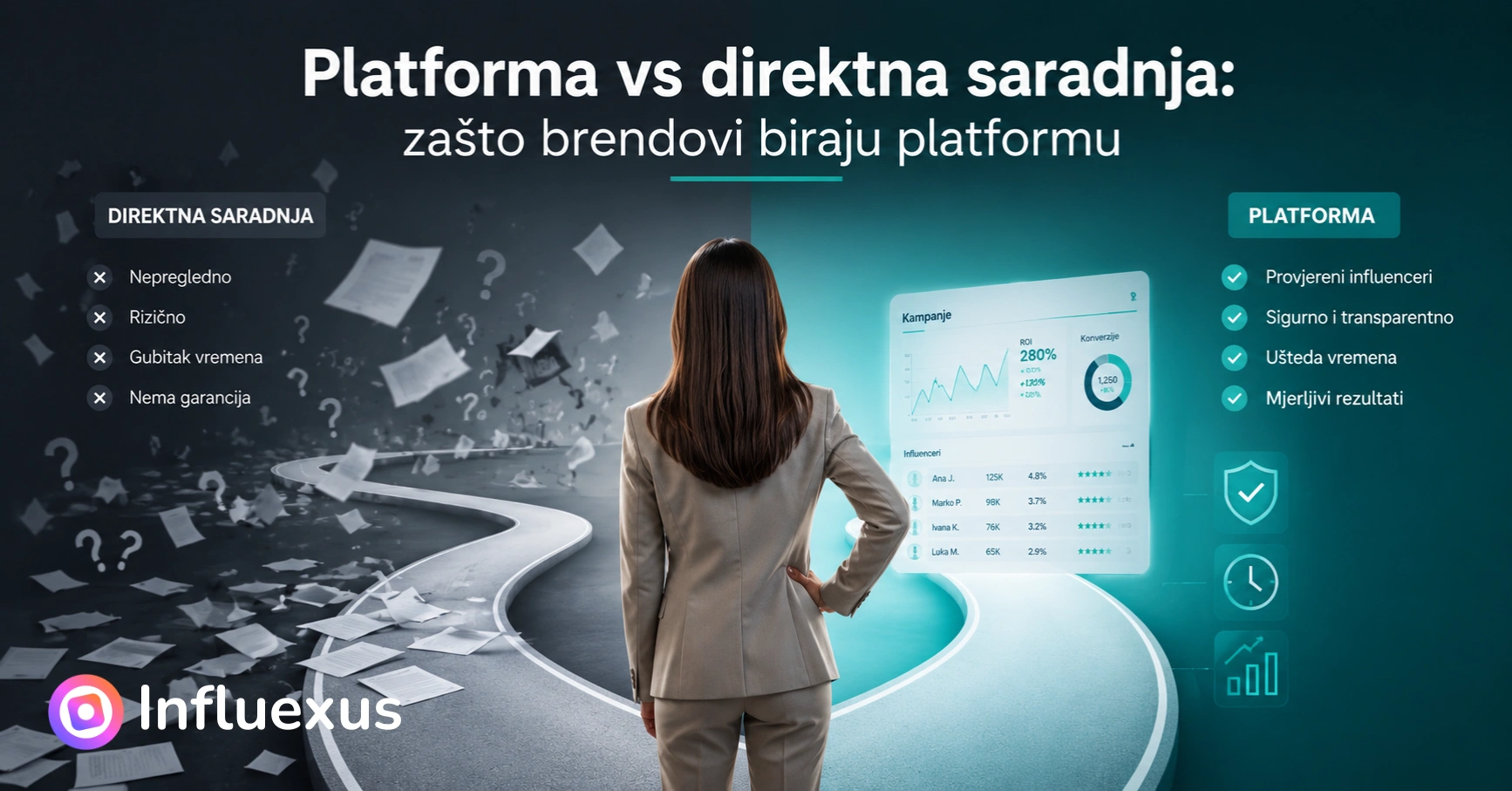
| Criterion | Direct collaboration | Platform (Influexus) |
|---|---|---|
| Influencer search | Manual, search hours | Filtered catalog, minutes |
| Statistics check | Only what the influencer sends | Verified data on the profile |
| Negotiation | Ad hoc, no reference prices | Transparent price lists |
| Payment protection | No, risk of losing money | Escrow, money goes only after delivery |
| Contract and legal protection | Prepare yourself or without a contract | Standardized conditions in the platform |
| Transaction cost | No platform transaction cost | 10% transaction cost |
| Scalability | Heavy, linearly growing effort | Multiple campaigns in parallel |
The only real argument for the direct route is to avoid the transaction cost. On Influexus, that cost for brands is 10% per successful collaboration, which, with all the advantages the platform brings, is often lower than the cost of the team's working hours.
Risks that remain invisible until they happen
Three recurring scenarios in direct-to-business brands:
Direct cooperation: risks
- Influencer takes money, does not publish content
- The post does not meet the agreed requirements
- Statistics are inflated with fake followers
- The influencer deletes the post after a week
- No record of agreement, dispute over terms
Platform: how it solves the same problems
- The money remains in escrow until the brand approves the content
- The brief and requirements are documented in the platform
- Profiles have verified engagement data
- The terms of cooperation have been agreed and recorded
- Both parties have a written agreement
When direct cooperation makes sense
Direct cooperation works when specific conditions are met:
- You have a long-term relationship with an influencer who has already delivered you quality work
- It is a celebrity partnership where the contract is signed formally anyway
- The campaign is a one-off, the brand is ready to take the risk
- The internal team has the capacity to manage the process
For all other scenarios, especially for brands that want to test influencer marketing or run multi-creator campaigns, the platform eliminates wasted time and financial risk.
Practical advice: Even if you work directly with some influencers, the platform can serve as a search and verification tool. Profiles and statistics are publicly available, and the decision about the cooperation channel remains up to you.
What the platform does not solve for you
A platform is not a magic wand. Some responsibilities always remain with the brand:
- Strategic selection of influencers that match your brand and target group
- Creative brief which gives enough freedom while ensuring message consistency
- Measuring results through promo codes, UTM links or direct sales tracking
- Budget decision and distribution between creators
The platform speeds up logistics and protects money. The strategy is up to you. That's right: no one knows your brand better than you, and no tool can replace that.
Influexus and regional context
Influexus is built specifically for the Balkans: Bosnia and Herzegovina, Croatia, Serbia and Montenegro. This means that creators on the platform are relevant to regional audiences, communication is in the local language, and the platform understands the local context of prices and market norms.
For a brand that targets regional customers, a platform with a global reach usually does not bring the right creators. Influexus was made exactly for this space.